
jason@hrcstone.com
+8613338485850
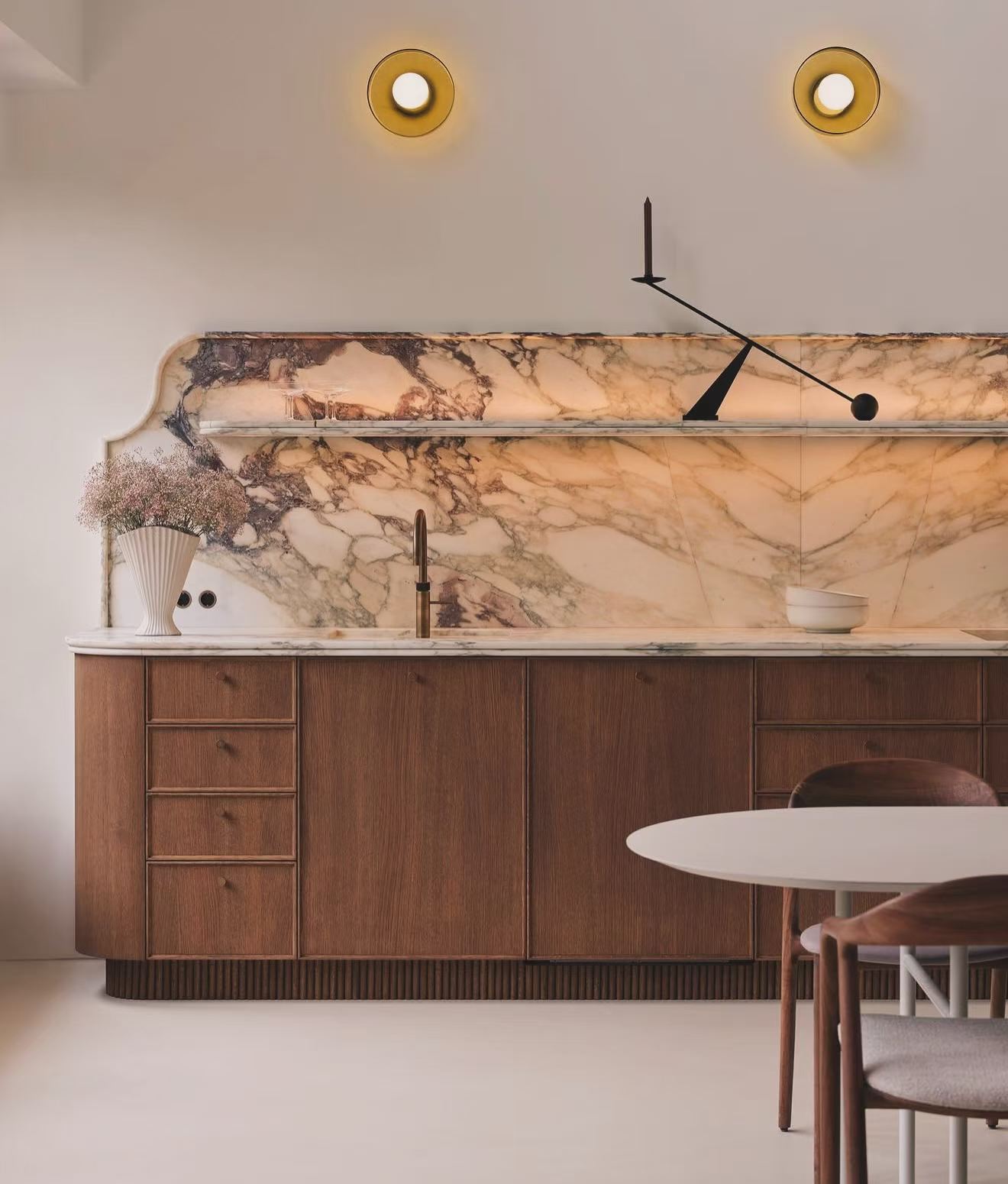
Calacatta Viola Marble is one of the most distinctive Italian marbles used in contemporary luxury interiors. Recognized by its creamy white to ivory background, dramatic burgundy and violet veining, and expressive brecciated movement, this natural stone turns architectural surfaces into visual focal points.
Unlike quieter white marbles selected primarily for neutrality, Calacatta Viola Marble is chosen when the stone itself is intended to become part of the design language. Large-format slabs can display sweeping wine-red veins, fragmented mineral formations, soft grey shadows, and occasional warmer tonal areas that create significant depth across the surface.
For architects, interior designers, stone distributors, contractors, fabricators, and luxury homeowners, however, selecting Calacatta Viola involves more than choosing an attractive slab. Vein distribution, block selection, slab sequence, bookmatching potential, finish, thickness, fabrication planning, sealing, and batch consistency can all influence the finished project.
We therefore approach Calacatta Viola as both a premium decorative marble and a project material that requires careful slab-by-slab evaluation.
Calacatta Viola Marble is a premium natural marble associated with the Carrara stone-producing region of Italy, internationally recognized for its pale background and dramatic violet, burgundy, wine-red, grey, and sometimes warm mineral veining.
The word Viola refers to the characteristic purple or violet coloration that distinguishes the material from many other Calacatta varieties.
Its appearance may range from relatively open white backgrounds crossed by isolated burgundy veins to highly expressive brecciated slabs containing dense clusters of purple, grey, cream, and reddish mineral movement.
This substantial natural variation is fundamental to the identity of the stone.
No two slabs are exactly identical.
For that reason, Calacatta Viola should not be evaluated only from a small sample. For feature walls, kitchen islands, fireplace surrounds, reception areas, bathrooms, and other visually important installations, full-slab selection is strongly recommended.
| Property | Typical Description |
|---|---|
| Material | Natural Marble |
| Commercial Name | Calacatta Viola Marble |
| Origin | Italy |
| Primary Background | White, creamy white, ivory |
| Veining | Burgundy, violet, purple, wine-red, grey |
| Pattern | Dramatic, brecciated, irregular |
| Variation | High |
| Common Finish | Polished, honed |
| Typical Supply | Slabs, cut-to-size panels, tiles, fabricated pieces |
| Popular Applications | Kitchen islands, countertops, feature walls, bathrooms, fireplaces, reception areas |
| Design Character | Dramatic, artistic, luxurious |
| Slab Selection | Strongly recommended |
| Bookmatching | Possible depending on slab sequence and block structure |
Because natural marble varies considerably between quarry blocks, individual project batches should be evaluated according to actual slab photographs, dimensions, finish, structural condition, and fabrication requirements rather than generic reference images alone.
The appeal of Calacatta Viola comes primarily from contrast and individuality.
Many premium white marbles rely on subtle grey or gold veining. Calacatta Viola introduces a considerably stronger visual identity through burgundy, purple, wine-red, and darker mineral formations.
This makes it particularly effective in interiors where designers want one material to establish the visual hierarchy of the space.
A large Calacatta Viola kitchen island, for example, can become the dominant architectural element without requiring additional decorative materials. Similarly, a bookmatched marble wall behind a reception desk or fireplace can create an installation closer to natural artwork than conventional wall cladding.
Its appeal also fits current luxury design preferences for authentic natural materials.
Rather than pursuing perfectly uniform surfaces, many high-end residential and hospitality projects intentionally celebrate geological variation, mineral movement, natural fissures, and irregular veining.
Calacatta Viola performs exceptionally well within this design philosophy.
One of the most important considerations when sourcing Calacatta Viola is that the commercial name describes a family of appearances rather than one completely uniform visual standard.
The background typically ranges from crisp white to creamy white or ivory.
Some blocks contain large open areas of pale marble, while others show substantially more grey shading and mineral activity.
For minimalist projects, architects may prefer slabs with cleaner white areas and strategically distributed purple veins.
For highly decorative interiors, heavily brecciated selections may be more desirable.
Deep burgundy is one of the signature characteristics of premium Calacatta Viola.
These veins can appear as:
broad mineral bands,
fragmented brecciated formations,
fine branching lines,
concentrated burgundy islands,
irregular wine-red clouds.
The proportion of burgundy dramatically changes the overall character of the slab.
Purple and violet tones give the stone its internationally recognizable identity.
Under different lighting conditions, these areas may appear burgundy, plum, violet, dark red, or reddish brown.
Designers should therefore evaluate actual slabs under lighting conditions similar to those planned for the project whenever possible.
Grey veining frequently accompanies the stronger purple formations and helps transition between the pale background and darker veins.
These neutral tones can make Calacatta Viola surprisingly compatible with concrete, stainless steel, brushed metal, dark timber, oak, walnut, and other contemporary materials.
Small marble samples are useful for confirming basic color, surface finish, and material identity, but they cannot communicate the full composition of a highly variable stone.
Calacatta Viola is a clear example.
A 100 × 100 mm sample may contain almost entirely white marble, while another sample from the same slab could contain dense burgundy veining. Neither represents the complete visual composition.
For important projects, we recommend evaluating:
Full-slab appearance – overall balance between background and veining.
Slab sequence – particularly when several adjacent panels are required.
Vein direction – essential for islands, walls, floors, and fabricated edges.
Natural variation – including differences between individual slabs.
Fissures and resin treatment – especially around heavily brecciated areas.
Usable dimensions – after accounting for natural features and fabrication requirements.
Bookmatching potential – when mirrored architectural compositions are planned.
For large residential or hospitality projects, digital slab mapping can also help allocate individual pieces before fabrication.
Bookmatching is one of the most effective ways to use Calacatta Viola Marble.
Adjacent sequential slabs can be opened and positioned so that their veins create a mirrored composition.
The resulting installation may resemble butterfly wings, abstract ink paintings, geological landscapes, or large-scale contemporary artwork.
Popular bookmatched applications include:
double-height entrance walls,
hotel lobby feature walls,
luxury bathroom walls,
fireplace surrounds,
villa entrance halls,
restaurant interiors,
reception backdrops,
master bedroom feature walls.
Not every slab pair produces an equally attractive bookmatch.
The most successful layouts depend on vein direction, slab sequence, cutting orientation, dimensions, and the location of dominant mineral formations.
For this reason, bookmatching should ideally be considered during slab selection rather than after fabrication begins.
flowchart LR
A[Sequential Calacatta Viola Slabs] --> B[Full-Slab Inspection]B --> C[Identify Dominant Vein Direction]C --> D[Digital Layout]D --> E{Design Objective}
E -->|Symmetrical| F[Bookmatch]E -->|Continuous Flow| G[Vein Match]E -->|Individual Feature| H[Single Slab Composition]F --> I[Fabrication Plan]G --> I
H --> I
I --> J[Final Installation]One of the most searched applications for the material is Calacatta Viola kitchen countertops, particularly statement kitchen islands.
Its bold veining works especially well with large waterfall islands where uninterrupted slab surfaces allow the geological pattern to remain visible.
For a waterfall island, slab allocation is critical.
The countertop and vertical return can often be planned so the vein movement visually continues over the edge. When executed successfully, this creates the impression that the marble has been folded around the island.
Accurate cutting plans and vein-matching layouts are therefore considerably more important than simply ordering sufficient square meters.
Calacatta Viola can be used for residential countertops, but it remains natural marble rather than engineered quartz.
Marble is calcium-carbonate based and can react with acidic substances such as lemon juice, vinegar, wine, and some household cleaners.
Proper sealing, appropriate cleaning products, and realistic expectations regarding natural patina are important.
For clients who appreciate the evolving character of genuine marble, these characteristics are often accepted as part of the material's authenticity.
Using Calacatta Viola as both countertop and backsplash can create an immersive stone composition.
Alternatively, designers may use a dramatic Calacatta Viola backsplash with quieter cabinetry and countertops, allowing the marble to become the primary feature.
Bathrooms provide another ideal environment for highlighting the stone's dramatic veining.
Large-format wall panels can minimize grout lines and create a visually continuous marble surface.
Common applications include:
vanity countertops,
vanity fronts,
shower walls,
bathtub surrounds,
feature walls,
bathroom floors,
niches and shelves,
integrated stone details.
For wet areas, installation specifications, waterproofing, sealing, substrate preparation, joint planning, and appropriate maintenance should be determined according to the particular application.
A honed finish may be preferred for certain floors, while polished slabs are frequently selected for walls and vanity surfaces where maximum depth and color contrast are desired.
A fireplace naturally establishes a focal point, making it particularly compatible with a visually expressive marble.
Calacatta Viola fireplace surrounds can range from minimal slab installations to highly detailed traditional profiles.
Contemporary designs often use one large slab or symmetrical bookmatched panels.
More classical interiors may incorporate:
profiled edges,
carved surrounds,
cornices,
mouldings,
hearth pieces,
integrated shelves.
Because the material combines a traditional Italian marble identity with unconventional purple and burgundy movement, it can bridge classical architecture and contemporary interior design particularly effectively.
Calacatta Viola is increasingly specified beyond private residences.
For boutique hotels, luxury retail, restaurants, clubs, branded residences, and premium commercial interiors, natural stone can contribute significantly to the perceived quality of a space.
Potential applications include:
reception counters,
lobby feature walls,
bar fronts,
display plinths,
VIP lounge walls,
elevator surrounds,
washroom vanities,
retail counters,
decorative flooring inserts.
For commercial projects, however, aesthetic selection should be coordinated with technical requirements.
Traffic conditions, edge exposure, maintenance protocols, substrate design, panel dimensions, fixing methods, and replacement strategy should all be considered before final material approval.
Calacatta Viola and Calacatta Gold occupy different aesthetic positions despite belonging to the broader luxury Italian marble category.
| Feature | Calacatta Viola | Calacatta Gold |
| Background | White to creamy white | White to warm white |
| Main Veining | Burgundy, purple, violet, grey | Grey, beige, gold |
| Visual Character | Dramatic and artistic | Elegant and classical |
| Design Mood | Bold, expressive | Warm, refined |
| Statement Value | Very high | High |
| Popular Use | Islands, feature walls, bathrooms | Kitchens, bathrooms, flooring |
| Pairing Direction | Dark wood, burgundy, brass, neutral cabinetry | Warm timber, brass, beige, cream |
Neither stone is inherently superior.
The decision depends on the intended architecture.
For understated luxury, Calacatta Gold may integrate more quietly into the interior.
For a strong focal point, Calacatta Viola offers substantially greater visual drama.
Arabescato marble generally features more grey, charcoal, or darker linear movement against a white background.
Calacatta Viola adds burgundy and violet mineralization, producing a warmer and more unusual visual identity.
Architects searching for a traditional white Italian marble with complex movement may gravitate toward Arabescato.
Projects seeking a more artistic, distinctive, and immediately recognizable statement may favor Calacatta Viola.
Carrara Marble typically offers a softer, more uniform appearance with fine grey veining.
It is widely used across residential and commercial architecture and generally provides a quieter aesthetic.
Calacatta Viola occupies a very different design category.
Carrara often functions as a sophisticated background material.
Calacatta Viola frequently functions as the centerpiece.
This distinction is particularly important when budgeting a project. Using premium marble selectively on focal surfaces can sometimes create greater visual impact than applying expensive stone indiscriminately throughout an entire interior.
Finish substantially influences the appearance of the material.
A polished surface intensifies color and contrast.
The white background appears brighter, while burgundy and violet mineral areas become deeper and more saturated.
Polished Calacatta Viola is particularly suitable for:
feature walls,
reception counters,
vanity tops,
kitchen islands,
fireplace surrounds,
decorative panels.
Honing creates a softer, lower-reflection surface.
The resulting appearance can feel more architectural and understated while maintaining the characteristic dramatic veining.
It is frequently considered for:
contemporary bathrooms,
floors where appropriate,
minimalist kitchens,
wall cladding,
furniture applications.
Finish samples should ideally be evaluated before a large project enters production because surface treatment can noticeably alter perceived color.
Because the stone already contains strong visual movement, surrounding materials should generally support rather than compete with it.
Walnut, smoked oak, dark-stained timber, and similar woods can complement the deep burgundy veins while introducing warmth.
This combination works particularly well in luxury kitchens, bars, libraries, and private residential interiors.
White or warm-white cabinetry allows the veins to become the main source of color.
The result is clean and contemporary while still retaining strong visual character.
Furniture, textiles, artwork, or joinery that subtly references the stone's wine-red mineralization can produce a highly coordinated interior.
The key is restraint.
Brushed brass, antique brass, and warm metallic finishes complement the cream and burgundy tones particularly well.
This pairing is frequently suitable for hospitality interiors and sophisticated residential bathrooms.
Black metal, blackened steel, dark cabinetry, or Nero Marquina-type accents can create a highly graphic contemporary composition.
Architectural stone procurement should begin with the design intent.
If a designer requires a symmetrical feature wall, slab sequence and bookmatching capability become priorities.
If the project involves a large kitchen island, usable slab dimensions and vein direction may be more important.
If hundreds of square meters are required for a hospitality project, block availability and batch consistency become critical.
We therefore recommend defining the following before final slab confirmation:
application,
finished dimensions,
required quantity,
preferred background tone,
desired vein intensity,
bookmatch requirements,
finish,
thickness,
edge details,
installation sequence.
This information allows stone selection to move beyond general aesthetic preference and become a practical architectural specification.
Wholesale purchasing involves different priorities from individual residential projects.
A distributor may require slabs that appeal to a broad customer base, while a project supplier may prioritize consistency across a predetermined architectural schedule.
For wholesale inventory, desirable factors often include:
attractive full-slab composition,
commercially useful dimensions,
balanced white-to-purple ratio,
strong polishing quality,
manageable natural fissures,
consistent slab thickness,
sequential availability,
clear slab identification.
For container orders, reviewing the actual available slabs before loading can significantly reduce discrepancies between expected and received material.
Large-scale stone procurement requires more than multiplying a sample approval across the required square meters.
Natural stone changes from block to block.
For hotels, villas, luxury apartments, retail developments, and commercial interiors, we recommend establishing an approved visual range.
This may define acceptable:
background color,
vein density,
burgundy intensity,
grey mineralization,
brecciation,
natural fissures,
repaired areas,
slab dimensions.
Once the visual range is established, slabs can be graded and allocated according to their final installation positions.
Highly expressive slabs may be reserved for prominent areas, while quieter slabs can be assigned to secondary locations.
This approach can improve both aesthetic consistency and material utilization.
Calacatta Viola contains dramatic mineral structures that may include natural fissures and brecciated areas.
Professional fabrication is therefore important.
Depending on the slab and fabrication requirements, processing may involve reinforcement, resin treatment, mesh backing, careful cutting sequences, and specialized handling.
Particular attention should be given to:
Vein-sensitive cuts: Important veins should not be unintentionally removed during nesting.
Large openings: Sink and cooktop cutouts require appropriate fabrication planning.
Mitred edges: Vein continuation should be considered before cutting the adjoining pieces.
Large-format panels: Handling procedures should reflect the slab's natural structure.
Bookmatched walls: Every panel should be numbered according to the approved installation drawing.
For complex projects, a digital cutting layout before production can significantly improve the relationship between the approved slabs and the finished architectural surfaces.
Proper installation is essential for premium marble.
Substrates should be appropriately prepared, stable, level, and compatible with the selected installation system.
Light-colored natural stone may require carefully selected setting materials to reduce the risk of discoloration or shadowing.
Calacatta Viola should also be sealed with a suitable natural-stone sealer according to the application and manufacturer's recommendations.
Routine care should avoid strongly acidic or abrasive cleaners.
For kitchen installations, spills such as wine, citrus juice, vinegar, tomato-based liquids, and similar acidic substances should be cleaned promptly.
Marble naturally develops character with use. Clients seeking a completely unchanged surface throughout its lifetime should understand this characteristic before selecting natural marble for intensive countertop applications.
Quality cannot be determined by vein color alone.
A commercially valuable slab combines aesthetics, dimensions, structural condition, processing quality, and suitability for its intended application.
We recommend evaluating:
Does the slab have a balanced and attractive distribution of white background and dramatic veins?
Is the desired white or cream tone sufficiently consistent across the selected batch?
Are the burgundy and purple veins positioned appropriately for the intended design?
Are natural fissures manageable for the planned fabrication?
Is the polish uniform and free from obvious processing defects?
Can the required pieces be obtained without compromising important vein areas?
Are sequential slabs available when bookmatching or continuous vein flow is required?
For premium projects, the most expensive slab is not automatically the best slab. The best selection is the slab—or sequence of slabs—that works most effectively with the architecture.
The price of Calacatta Viola Marble can vary considerably.
Rather than having one universal market price, slab value depends on several variables:
quarry and block selection,
background whiteness,
vein color and composition,
slab size,
thickness,
surface finish,
structural quality,
rarity of the pattern,
sequential slab availability,
current inventory,
order quantity,
fabrication requirements.
Highly decorative slabs with strong burgundy movement and attractive white backgrounds may command substantial premiums.
Large sequential sets suitable for bookmatching can also carry additional value because they provide design possibilities that isolated slabs cannot.
For project purchasing, quotations should therefore be based on actual slab or batch selection whenever possible.
Before confirming a substantial order, professional buyers should request more than one attractive promotional photograph.
Useful procurement information includes:
current slab photographs,
full-slab videos,
slab dimensions,
thickness,
finish,
available quantity,
slab numbering,
sequential slab information,
close-up images,
packing method,
fabrication capability where required.
For architect-led projects, marked slab layouts can also help confirm exactly where each finished piece will originate.
This creates a much clearer connection between material selection, fabrication, and final installation.
flowchart TD
A[Project Design & Stone Specification] --> B[Define Quantity, Finish & Thickness]B --> C[Review Current Calacatta Viola Slabs]C --> D[Select Approved Slab Range]D --> E[Slab Numbering & Digital Layout]E --> F[Bookmatch / Vein Match Planning]F --> G[Cut-to-Size Fabrication]G --> H[Dry Layout & Quality Inspection]H --> I[Protective Packing]I --> J[International Shipping]J --> K[Site Installation]K --> L[Completed Luxury Interior]
For high-value natural stone, the workflow is as important as the material itself.
A spectacular slab can produce a disappointing installation if vein orientation, panel allocation, fabrication, or installation sequence is poorly controlled.
Conversely, intelligent material planning can substantially increase the architectural impact of the available stone.
Yes. Calacatta Viola is a natural marble known for its white or creamy background and dramatic burgundy, violet, purple, and grey mineral movement.
Calacatta Viola is associated with the Italian marble industry and the Carrara stone-producing region.
It typically combines a white to ivory background with burgundy, wine-red, purple, violet, and grey veining.
Yes, it is widely used for luxury kitchen countertops and islands. As with other natural marbles, appropriate sealing and care are recommended because acidic substances can etch marble.
Yes. Large slabs and dramatic vein movement make it particularly attractive for waterfall kitchen islands. Vein matching should be planned before fabrication.
Yes, sequential slabs can often be used for bookmatched installations, depending on the block, cutting sequence, and available slabs.
Yes. It is frequently selected for luxury bathroom walls, vanity areas, shower surrounds, and feature surfaces.
It can be used for suitable interior flooring applications, subject to the project's traffic, finish, slip-resistance, installation, and maintenance requirements.
Calacatta Viola is characterized by burgundy and purple movement, while Calacatta Gold generally features grey and warm golden veining.
Carrara is usually softer and more uniform with grey veining. Calacatta Viola has substantially stronger contrast and is generally selected as a statement material.
Neither is universally better. Polishing increases depth and contrast, while honing creates a softer and more architectural appearance.
Sealing is generally recommended for natural marble, particularly in kitchens, bathrooms, hospitality spaces, and other areas exposed to liquids.
No. Natural variation can be significant, making full-slab inspection particularly important.
Pricing can reflect block quality, background color, vein composition, slab dimensions, structural condition, rarity, finish, and sequential availability.
Yes. It is especially effective for hotel reception areas, lobby walls, bathrooms, bar fronts, and other visually important interior surfaces when the specification suits the application.
Yes. Depending on the supplier and fabrication facility, slabs can be processed into countertops, wall panels, vanity tops, tiles, fireplace pieces, and other custom components.
For visually important installations, yes. Approving actual slabs and preparing layouts before fabrication provides considerably greater control over vein placement and finished appearance.
Yes. Its rarity, natural variation, dramatic color, and ability to create large uninterrupted compositions make it particularly suitable for high-end villas, penthouses, bespoke residences, and architect-designed homes.
The strongest Calacatta Viola projects begin with the actual slabs rather than a generic material name.
For architects and interior designers, full-slab selection provides control over pattern, scale, vein direction, bookmatching, and the relationship between stone and surrounding materials.
For construction companies and project managers, batch planning, dimensions, fabrication drawings, inspection, packing, and installation sequencing become equally important.
For stone wholesalers and distributors, commercially attractive slab composition, reliable processing, inventory continuity, and container-level quality control influence the success of the material after arrival.
For luxury homeowners, selecting the actual slabs provides the opportunity to choose a unique geological composition that will become a permanent part of the interior.
Luxury stone is not simply about rarity or price.
Its value comes from the relationship between natural material, architecture, craftsmanship, and intelligent selection.
Calacatta Viola succeeds because it does not disappear into an interior.
Its creamy background provides the familiarity of classical Italian white marble, while the intense burgundy and violet formations introduce an unmistakably contemporary personality.
Used selectively, it can define an entire room.
Used across carefully matched slabs, it can create architectural compositions that resemble monumental natural artwork.
Used with disciplined fabrication and thoughtful material pairing, it can work equally well in a modern penthouse, a classical villa, a boutique hotel, a luxury retail environment, or a bespoke residential kitchen.
For projects requiring Calacatta Viola Marble slabs, bookmatched panels, kitchen islands, countertops, bathroom walls, fireplace surrounds, cut-to-size stone, or project-scale marble supply, we recommend beginning with the current slab selection rather than relying solely on reference photographs.
The final result depends not only on choosing Calacatta Viola—but on choosing the right Calacatta Viola slabs for the architecture.
Contact: Jason Wu
Phone: +8613313887269
E-mail: jason@hrcstone.com
Whatsapp:+8613338485850
Add: Room 401-6, No.751, Fanghu Road, Huli District, Xiamen
We chat