jason@hrcstone.com
+8613338485850
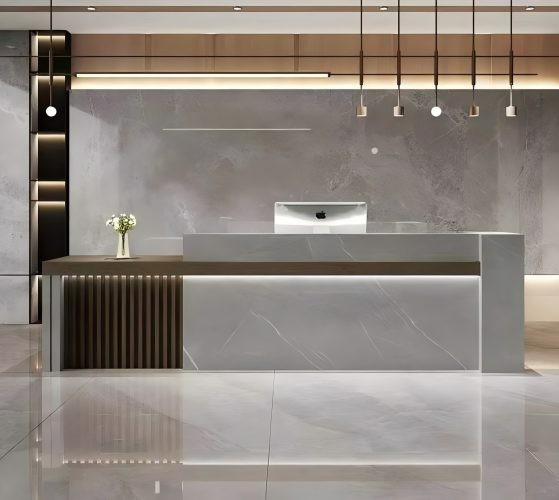
Your reception desk is the first handshake with your clients. In 2026, it's more than just a piece of furniture; it's a strategic statement of your brand's identity, efficiency, and vision. This comprehensive guide delves into the world of modern reception desks, blending cutting-edge design trends with practical considerations for material selection, dimensions, and maintenance.
Whether you're an architect specifying for a new build, an interior designer curating a space, or a business owner seeking to make a powerful first impression, this guide provides the insights you need.
The choice of stone for a reception desk is paramount, influencing aesthetics, durability, and maintenance. Modern design favors stones that offer clean lines, subtle veining, and a sense of solidity.
| Stone Type | Key Characteristics | Best For |
|---|---|---|
| Quartz | Non-porous, highly durable, consistent patterns, low maintenance. | High-traffic offices, healthcare, hospitality. |
| Granite | Extremely hard, heat & scratch resistant, unique natural patterns. | Corporate lobbies, law firms, financial institutions. |
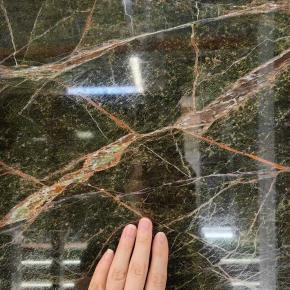
| Marble | Luxurious veining, classic elegance, requires sealing. | Design studios, luxury boutiques, high-end hotels. |
| Porcelain Slabs | Lightweight, versatile designs, stain & UV resistant. | Contemporary spaces, curved designs, large format applications. |
Quartz, engineered from natural quartz and resin, leads in popularity due to its uniformity and resilience. Granite offers unmatched natural beauty and strength. Marble remains the epitome of luxury but demands more care. Porcelain slabs are the rising star, enabling bold, seamless designs with minimal seams.
Modern fabrication allows for impressive scale. Standard slab sizes are typically 120" x 60" or 126" x 63". For a truly monolithic look, jumbo slabs (up to 130" x 65" or larger) are increasingly available, reducing seams in long reception counters.
Thickness is a critical design and structural decision:
2cm (3/4"): Often used with a built-up edge (plywood substrate) to create the appearance of a thicker slab. Lighter and more cost-effective.
3cm (1 1/4"): The industry standard for stone countertops. Offers a substantial feel and good structural integrity for most applications.
4cm+ (1 1/2"+): Used for a bold, monolithic statement. Often seen in high-end corporate or hospitality settings. Requires robust structural support.
Consider the overall design: a floating desk may use a thinner slab for a lighter visual, while a solid base design can handle greater thickness for a powerful presence.
The modern reception desk is evolving from a static barrier to a dynamic, experiential element.
Biophilic Integration
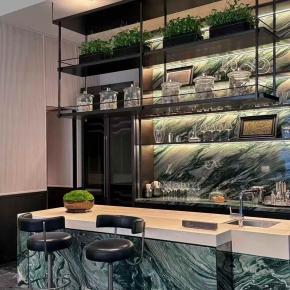
Incorporating living walls, integrated planters, or stone with organic, flowing patterns to connect occupants with nature and reduce stress.
Tech-Enabled Surfaces
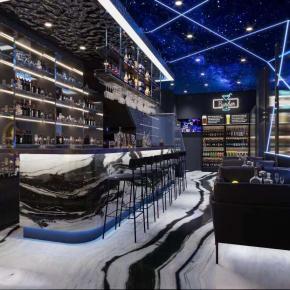
Discreet wireless charging pads, embedded LED lighting for wayfinding or branding, and touch-screen kiosks seamlessly built into the stone.
Curved & Organic Forms
Moving away from sharp corners towards soft, rounded edges and fluid shapes that feel more inviting and accessible.
Mixed Materiality
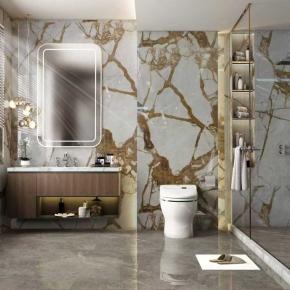
Combining stone with warm woods, matte metals (like brushed brass or gunmetal), or translucent acrylic to add texture and visual interest.
A beautiful desk must also function flawlessly for both staff and visitors. The standard ergonomic height for a standing-height reception desk is 42"-45". For seated reception, 29"-30" is typical.
Critical functional zones include:
Transaction Area: A lowered section (typically 34"-36" high) for comfortable writing or device interaction.
Knee Space & ADA Compliance: Ensure at least 27" of clear knee space height, 30" of width, and 19" of depth to accommodate wheelchair users.
Cable Management: Integrated grommets, raceways, and access panels are essential for a clean, wire-free appearance.
Proper maintenance preserves the desk's beauty and longevity. Daily cleaning with a pH-neutral stone cleaner and a soft cloth is sufficient for most stones. Avoid abrasive pads and harsh chemicals.
Sealing is crucial for porous stones like marble and some granites. Consult with your fabricator for the recommended sealing schedule. For quartz and porcelain, sealing is generally not required due to their non-porous nature.
Address spills immediately, especially those containing acids (coffee, wine, citrus) or oils.
In conclusion, the modern reception desk in 2026 is a fusion of material science, empathetic design, and smart technology. By understanding the interplay of stone properties, dimensional possibilities, ergonomic needs, and evolving trends, you can specify or select a reception solution that is not only visually stunning but also deeply functional and strategically aligned with your brand's forward-looking identity.
Contact: Jason Wu
Phone: +8613313887269
E-mail: jason@hrcstone.com
Whatsapp:+8613338485850
Add: Room 401-6, No.751, Fanghu Road, Huli District, Xiamen
We chat